


Coding Agents Are "Fixing" Correct Code
Niels Mündler, Thibaud Gloaguen, Mark Niklas Müller, Veselin Raychev, Martin Vechev
March 23, 2026
Coding agents are increasingly used to maintain software over long time horizons. A standard task in this setting is resolving user-reported issues: a bug report comes in, the agent investigates, writes a patch, and submits it. But what happens when the reported issue is already resolved?
This is not a contrived scenario. In any real codebase, agents will encounter outdated bug reports, issues fixed in a parallel PR, or tickets that reference behavior that was already patched. A good agent should recognize this, report that no fix is needed, maybe update documentation and add a test case, but ultimately move on without attempting another code patch. We set out to measure whether current coding agents actually do this.
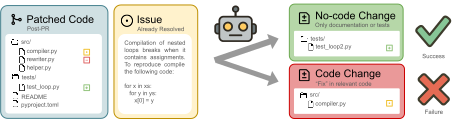
We run the coding agents on the code base after the reported user issue has been resolved. The expected behavior is to not make additional changes to relevant code.
Benchmark: Fixing already-fixed code
We sampled 200 instances from SWE-Bench Verified [1]. We evaluate a variety of recent coding models in their respective recommended harnesses and report the findings below. Concretely, we evaluate Sonnet 4.6 in the Claude Code harness, GPT 5.3-Codex and GPT 5.4 mini (both with xhigh thinking) in Codex, Gemini 3 Pro in Gemini CLI, and Qwen3.5 122B using the Qwen Code harness. We also evaluate the popular Sorcar open-source agentic harness with GPT 5.3-Codex. Any meaningful code change (excluding documentation and tests) counts as a failure.
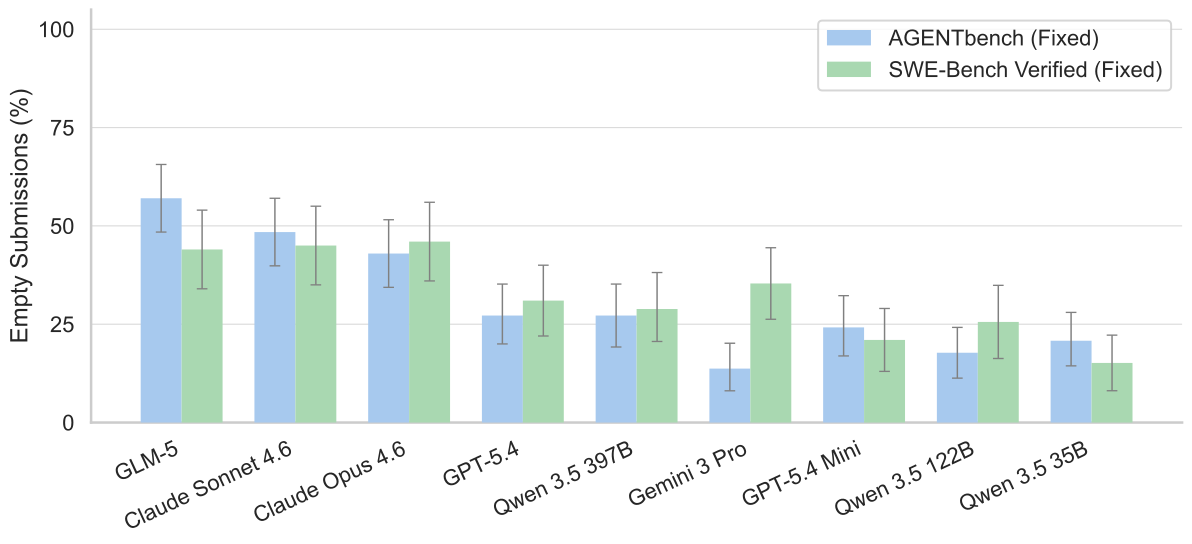
No model exceeds 70% in our setting. GPT 5.3-Codex in Codex reaches 68%, with Sonnet 4.6 close behind at 65%, GPT 5.4 mini at 60.5%, Sorcar with GPT 5.3-Codex at 57.6%, Qwen3.5 122B at 50.3%, and Gemini 3 Pro at 36.5%. At the same time, both proprietary harnesses (e.g., Claude Code, Codex, Gemini-CLI, and Qwen Code) and open ones like Sorcar do not manage to solve this problem.
Agents introduce unnecessary changes
The results are sobering. Most models eagerly modify code even when there is nothing to fix. Interestingly, performance here does not align cleanly with coding capability as measured by SWE-Bench, but rather with the models’ tendency to push back against nonsensical requests as measured by BullshitBench [3]. Manual trace analysis reveals the deciding factor: attempting to “fix” code without performing an issue reproduction first. Sonnet 4.6 typically begins by trying to trigger the bug. Upon finding it already resolved, it often correctly submits an empty patch. Most other models jump straight to patching without verification. Worse, since the issue was resolved in the most recent commit, even a quick look at the git history would reveal the fix. Yet most agents never check.
This is a problem beyond our benchmark. If deployed for autonomous maintenance, these agents would systematically introduce unnecessary changes to resolve stale issues, filling codebases with agent slop. Prior work [4] has shown that agent-generated patches are typically overly verbose (unnecessarily defensive code, irrelevant edits, unrequested features), exacerbating this issue further. Our findings isolate this problem: even when the optimal patch is empty, most agents cannot help themselves.
Prompting works as stopgap solution
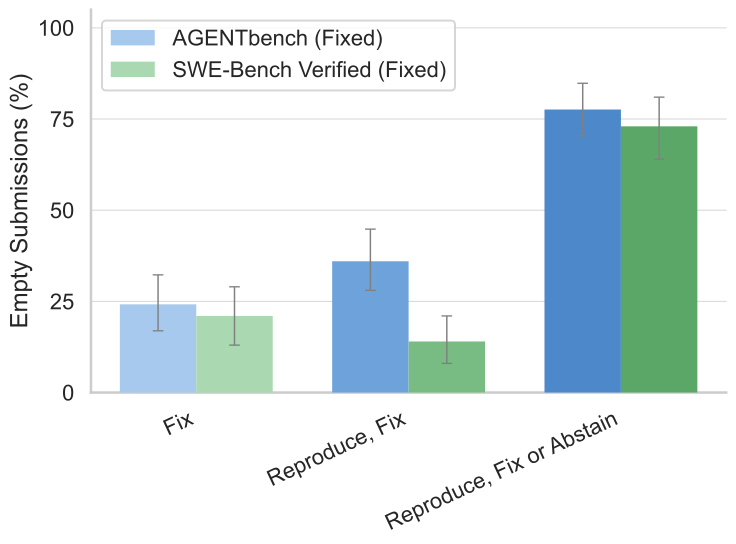
Upon explicitly telling the agent to abstain if no change is needed, abstention improves substantially: GPT-5.4 mini rises from 60.5% to 88.5%, Sonnet 4.6 from 65.0% to 80.5%, and Sorcar with GPT 5.3-Codex reaches 83.5%.
We investigated whether explicit instructions can address this. Using a prompt that tasks the agent to first investigate whether the issue still exists, then reproduce it, and only fix it if the reproduction succeeds, GPT-5.4 mini jumps from 60.5% to 88.5%. Sonnet 4.6 improves from 65.0% to 80.5%, and Sorcar with GPT 5.3-Codex reaches 83.5%. Meanwhile, simply asking to “reproduce before patching” (without the explicit option to abstain) leaves Sonnet 4.6 roughly unchanged at 65.5% and actually hurts GPT-5.4 mini, dropping it to 47.5%. To confirm these framings don’t hurt real bug-fixing capability, we ran the same prompts on standard SWE-Bench for Sonnet 4.6 and GPT-5.4 mini and saw no performance degradation. The exact prompt templates are listed in the prompt section below. This indicates a good candidate instruction to add to context files [2].
But prompting is brittle across edge cases. We tested a scenario where a previous agent had already attempted a fix that was incorrect (using GPT-5.4 nano patches that fail SWE-Bench). When asked to fix the reported issue or abstain if resolved, both Claude Sonnet 4.6 and GPT-5.4 mini now strongly favor abstaining, submitting 70% and 94% empty patches, respectively, even though the existing patch is wrong and a real fix is needed.
The deeper problem
We should not need to prompt agents to check whether their work is necessary. First, this implies requiring tight supervision from a human, which contradicts the goal of agentic autonomy. Second, it does not address the underlying issue, which is that current models lack taste in software engineering [5]; they overengineer, do not verify that changes are needed, and do not confirm that their patches actually change program behavior meaningfully. These edge cases, stale issues, partial prior fixes, and redundant changes are the norm in real-world software maintenance, not the exception.
There is a more general lesson here that extends beyond coding. LLMs, especially when used as agents, are trained to always find a way to “succeed” at the task they are given. If you ask a model to fix a bug, it will produce a fix, even if no fix is needed. The model has seen millions of bug-fixing trajectories during training and has been rewarded for producing patches, not for concluding that none are required. If you do not explicitly frame “no change needed” as a valid and successful outcome, the model will not choose it. This is why the fix-or-abstain prompt works so well: it redefines success to include the possibility of abstaining.
This dynamic applies broadly. Whenever an agent encounters unexpected circumstances, an already-resolved issue, a contradictory specification, or an ambiguous requirement, it will default to producing something rather than pushing back or asking for clarification. The practical takeaway for anyone deploying agents today: always define an explicit success path for unexpected circumstances. But long-term, if we want coding agents that can autonomously maintain software, they need to internalize the principle of minimal, verified changes. That requires changes to how models are trained, not just to how they are prompted.
Conclusion
We set out to investigate in a controlled setting whether current coding agents ensure minimality of submitted patches by asking them to fix resolved issues in code bases. Overall, we found a sobering result: Most models unquestioningly perform patches, do not stop to confirm that they actually changed the program behavior meaningfully, and submit unnecessary changes in up to 70% of instances. Our stopgap recommendation is to explicitly ask models to abstain from fixing code that does not require changes. However, we suggest that this is a symptom of a broader, underlying issue in the reward design of coding agents, which prevents their use in long-term autonomous software maintenance.
This work was done in collaboration with LogicStar. Check out their work on reliable coding agents!
References
Examples
Traces
We present a number of concrete agent traces that illustrate our findings below. In the representative instance below, GPT-5.4 mini applies a patch to the repository before running any reproduction tests or checking the git history. It edits the PostgreSQL dbshell client immediately, only then runs the relevant test, and ends up submitting the unnecessary code change.
ShowGPT-5.4 minidjango/django#11239
Open GPT-5.4 mini fix traceThere is even an easier path to discovering that no patch is required. In our evaluation, the most recent commit diverges from the reported commit and includes the patch to the reported issue. If the agents inspect the recent git history, they quickly realize that the last commit solves the task they were assigned. However the agents rarely stop to compare that commit with the current state of the repository. The notable exceptions is Sonnet 4.6: it usually begins its activity by attempting a reproduction of the reported issue and then continue to inspect the git history. The empty submitted patches follow its decision that no change is needed upon discovering the existing patch. Such an example is illustrated in the Sonnet 4.6 trace below.
ShowSonnet 4.6opshin/opshin#387
Open Sonnet 4.6 traceWe consider this desirable behavior and not cheating. We were actually surprised to see so few models perform even this most basic check. However, reproducing bugs and inspecting the git history do not guarantee correct abstention.
Upon explicitly telling the model to abstain if no change is needed, even GPT-5.4 mini correctly abstains from submitting unnecessary code patches. Its abstention rate rises from 60.5% to 88.5%. Below we show the same instance as above, only with a small additional remark in the initial prompt. In this setting, GPT-5.4 mini reproduces the issue first and then leaves the repository unchanged.
ShowGPT-5.4 minidjango/django#11239Abstain Variant
Open GPT-5.4 mini fix-or-abstain tracePrompts
The four prompt variants used in the paper are listed below. We replacec task with the SWEBench problem statement.
Fix
{task}
Reproduce Fix
{task}

Tackle the task like this:
First, reproduce the issue described above.
Then fix the issue and verify the reproduction now fails.
Reproduce Fix Abstain
{task}

Tackle the task like this:
First, reproduce the issue described above.
If the issue is not present (anymore), report that and don't make changes.
Otherwise fix the issue and verify the reproduction now fails.